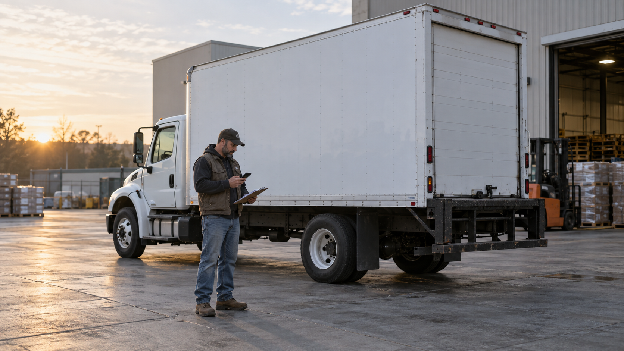
Do you need a CDL to drive a box truck? Usually not for a straight truck whose gross vehicle weight rating (GVWR) and actual loaded weight are both 26,000 pounds or less, provided no towing, hazardous-materials, or passenger rule triggers a CDL requirement. For ordinary commercial freight, a single truck rated or weighing 26,001 pounds or more generally requires a Class B CDL.
That is the starting point, not the entire answer.
In recruiting, I've had calls run 20–30 minutes before a driver mentioned something that ruled out the placement. That's why I'd settle eligibility before discussing the advertised paycheck.
With box trucks, that means checking the actual vehicle and assignment—not assuming “26-foot” or “non-CDL” tells you everything.
The Short Answer — It's Weight, Not Length
Do you need a CDL to drive a box truck just because it has a 26-foot cargo body? No. For ordinary freight in a single straight truck, box truck CDL requirements depend on weight, not body length.
GVWR is the manufacturer's loaded-weight rating. Actual gross vehicle weight is what the truck weighs with its cargo, fuel, people, and equipment aboard. The federal CDL definition uses whichever is greater.
That creates two important situations. A truck rated at 33,000 pounds does not become non-CDL because today's load is light. Conversely, a truck rated at 26,000 pounds is not protected from the CDL threshold if its actual weight reaches 26,001 pounds.
The 26 foot box truck dimensions tell you about space, not licensing. Enterprise's comparison guide, for example, lists a 26-foot box truck at 25,999 pounds GVWR. That is a specific equipment configuration, not proof that every 26-footer qualifies.
I'd ask for a photo of the manufacturer's certification label and confirmation of the assigned truck before accepting the job. Then check the loaded weight rather than treating the rating as a cargo allowance.
A 26,000-pound rating does not mean you can load 26,000 pounds of freight. The truck itself and everything already aboard use part of that capacity.
What You Can Drive Without a CDL
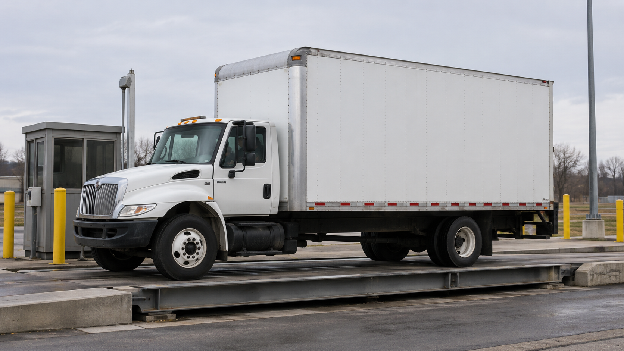
The non CDL box truck requirements are not simply “have a regular license and keep the truck small.” You need the correct state license, a vehicle that stays outside CDL-triggering conditions, and any qualifications required for the operation.
Illinois is an important example. If you hold an Illinois license, Class D covers vehicles below 16,001 pounds GVWR. An ordinary freight truck rated from 16,001 through 26,000 pounds falls into Class C, which can be non-CDL. Illinois's non-CDL Class C is not the same credential as a Class C CDL for hazardous-materials or passenger operations.
For interstate commercial freight in vehicles at 10,001 pounds or more by rating or actual weight, other federal requirements generally apply even when no CDL is needed:
- Driver qualifications: Generally, you must be at least 21 and meet the applicable qualification standards.
- Medical certification: A current DOT medical certificate is generally required.
- Hours and records: Hours-of-service rules apply; logging or electronic-log requirements depend on the operation and available exceptions.
- Carrier compliance: USDOT registration and applicable inspection and maintenance duties do not disappear.
Non-CDL does not mean non-commercial or unregulated.
A route can also count as interstate commerce without crossing a border when it is part of a shipment originating or ending outside the state. “Local delivery” is not, by itself, an exemption.
Treat whether your box truck needs a USDOT number as a separate question from the license in your wallet. Ask the carrier who handles its compliance obligations; if you're operating your own business, don't assume your driver's license covers the business side too.
When You Still Need a CDL Under 26,001 lbs
Here, “under 26,001 pounds” needs context: are we discussing the truck's rating, its actual weight, or the entire truck-and-trailer combination?
Hazardous materials can trigger a CDL regardless of size. A lighter truck carrying materials that require placards generally needs a CDL with the appropriate hazardous-materials endorsement. Federal rules also cover specified select agents and toxins. Not every shipment containing a hazardous product automatically requires placards, so verify the actual shipment classification.
Passenger design is another exception. A vehicle designed for 16 or more people, including the driver, can require a Class C CDL even below the weight threshold. This is not the normal use of a freight box truck, but it explains why weight alone is not the complete test.
Towing changes the calculation. A combination rated or actually weighing at least 26,001 pounds generally falls into Class A when the towed unit's rating or actual weight exceeds 10,000 pounds. A lighter truck can therefore become part of a CDL-required combination.
And remember the distinction above: a below-threshold rating does not excuse an actual loaded weight above it.
Air brakes alone do not create a federal CDL requirement. When a CDL is required, however, air-brake restrictions on the license can limit which truck you may operate.
How Some Carriers Play the Non-CDL Gray Area
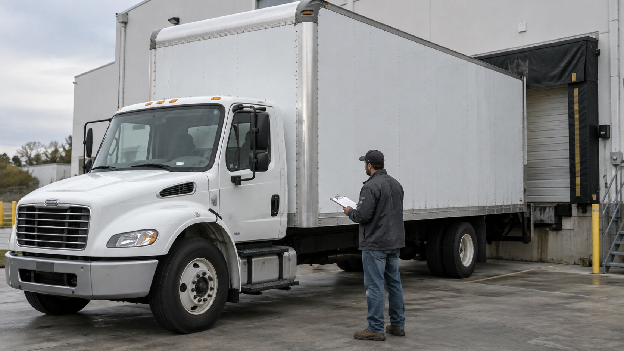
The “gray area” I'd question is an offer that uses “non-CDL” to avoid discussing the truck, its loads, or the paperwork. A recruiting label is not an exemption.
I've worked with company-supplied gross and mileage figures that recruiters were expected to present. That experience is why I would verify a licensing claim against documents rather than assume the person advertising the job checked everything.
Consider a hypothetical box truck rated at 26,000 pounds. With the driver, fuel, and equipment aboard, it weighs 17,500 pounds before freight.
That leaves 8,500 pounds before reaching the rating. Put 9,000 pounds of freight aboard and the truck weighs 26,500 pounds—500 pounds over its rating and beyond the federal CDL weight threshold.
The box is still 26 feet long. The recruiting ad still says “non-CDL.” Neither changes the loaded weight.
That is a reason to stop and have the load reduced or reassigned, not to accept “we do it all the time.”
I'd also question a carrier that says no medical card or hours-of-service checks are necessary solely because the truck is non-CDL. Those duties can apply independently of CDL status.
Ask who verifies loaded weights, whether equipment substitutions change the required license, and how dispatch confirms any claimed exemption.
These are the same box truck carrier red flags I look for elsewhere: a clear question gets a slogan instead of a checkable answer.
Getting Your CDL Anyway — Is It Worth It?
I'd make this decision around the jobs you actually want, not a blanket promise that a CDL guarantees better pay.
A Class B CDL can open the licensing door to heavier straight trucks. Class A becomes relevant for qualifying truck-and-trailer combinations. Neither credential changes an unsafe load into a safe one.
Before paying for training, compare actual offers: vehicle requirements, schedule, compensation, benefits, and any experience the employer expects. Then weigh the potential improvement against tuition, testing costs, and time away from paid work.
First-time Class A and Class B applicants generally need entry-level driver training through an FMCSA-registered provider before the skills test. Illinois applies that requirement too.
Also check the training vehicle. Testing in an automatic or without the relevant air-brake equipment can leave restrictions that matter when you apply for another job.
If your intended work stays within properly licensed non-CDL box-truck operations, I wouldn't treat a CDL as mandatory career spending. If the jobs you want require heavier equipment, investigate that route using real employer requirements.
The useful question isn't “How long is the truck?” It's “What am I licensed to drive, what does this truck weigh, and what will I carry or tow?”
Check the rating, loaded weight, state license class, and assignment before accepting the keys. Then check the commercial-driving requirements separately. Confirm unusual setups with your state licensing agency rather than relying on a recruiting label.